


Switzerland’s principal gambling authorities have completed a new online enforcement sweep, adding a fresh batch of unlicensed websites and domains to the Liste der Gesperrten Domain – commonly referred to as the Swiss blacklist.
The joint action, which was led by the Eidgenössische Spielbankenkommission (ESBK) and Gespa, targeted offshore gambling operators found to be offering casino games and sports betting services to Swiss consumers without the authorisation required under the Federal Gambling Act (Geldspielgesetz, BGS).
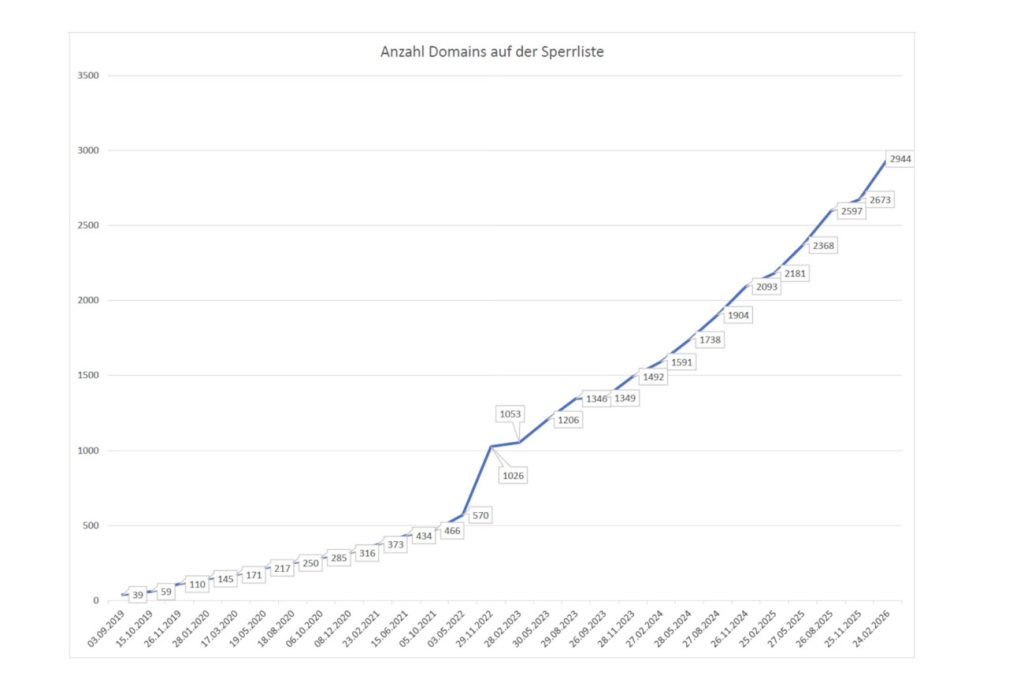
As of February 2026, cumulative updates published by ESBK and Gespa showed that the number of restricted domains has expanded to nearly 3,000 websites.
Enhanced monitoring
The authorities have been instructed to enhance the monitoring of media and online environments to ensure that Swiss players can only access licensed websites.
The command will see the Liste der Gesperrten updated on a more frequent basis via the coordination of ESBK and Gespa.
ESBK oversees online casino gambling, whilst Gespa serves as the inter-cantonal authority responsible for lotteries and sports betting. Both authorities are charged with applying the laws of the Swiss Money Gaming Act of 2018 (Bundesgesetz über Geldspiele, BGS),
Under the BGS, access to online gambling services must be restricted in the cases where an operator has not been granted a Swiss licence. This usually applies when the operator is based abroad, or where the origin of the service is deliberately concealed.
The legislation empowers regulators to impose network blocks on non-compliant domains, obliging Swiss internet service providers to technically prevent access from within the country.
ESBK will continue to identify and blacklist unauthorised online casino operators, while Gespa applies equivalent measures to unlicensed sports betting and lottery-style offerings.
The expansion in enforcement directives reflects sustained regulatory scrutiny of offshore operators that target Swiss consumers without securing domestic approval.
The state of play in Switzerland
Current BGS laws permit licences for online casinos – spanning slots, poker and roulette – that are only applicable to operators that have a partnership with canton approved land-based operators.
Operators that fail to meet these requirements fall outside the licensed system and are subject to blocking measures outlined by the Liste der Gesperrten.
ESBK continues its campaign to warn Swiss consumers of illegal gambling operators, by promoting the authorised licences since 2019 to the Swiss public.
Swiss consumers who access unlicensed websites are not said to be committing a criminal offence under the country’s Gambling Act, however authorities have consistently warned that accessing such sites carries consumer risk due to fewer player protection measures.
The rollout of licensed online casino platforms began in July 2019, led by Casino Baden, which launched jackpots.ch on 5 July 2019. This was followed by Casino Lucerne with mycasino.ch on 22 August 2019, and Casino Pfäffikon, which introduced online.swisscasinos.ch. To date ESBK promotes the nine regulated online casino partnerships of
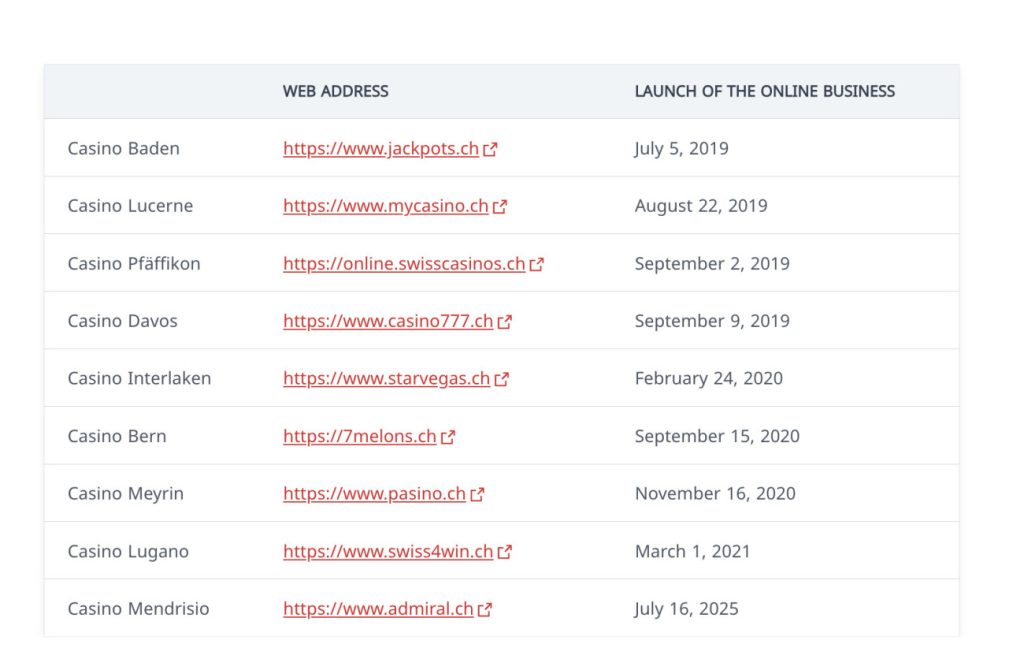
As of November 2025, Switzerland’s Federal Department of Justice and Police (FDJP) initiated a formal evaluation of the Money Gaming Act (Bundesgesetz über Geldspiele, BGS) of 2018, examining whether the objectives outlined in the framework have been effectively achieved since it was enacted in January 2019.
The review will assess the overall performance of the regulatory framework, including channelisation targets, player protection standards and market integrity safeguards. It will also scrutinise the enforcement mechanisms deployed by supervisory authorities, most notably Liste der Gesperrten.
DACH slow movements
The outcome of Switzerland’s review may prove consequential beyond its own borders. Proceedings in 2026 could signal definitive regulatory recalibration across the wider DACH gambling market, as neighbouring jurisdictions confront mounting pressure to reassess their own frameworks.
In Austria, political and legal demands to review the country’s gambling regime continue to intensify, particularly regarding the long-standing monopoly privileges granted to state-backed operators over online casino activities.
Calls for liberalisation – or at minimum structural reform – have gained traction amid ongoing legal disputes and scrutiny of the monopoly’s compatibility with EU market principles.
Meanwhile in Germany, federal states have begun preliminary coordination to examine the liabilities and structural shortcomings of the Fourth Interstate Treaty on Gambling (GlüStV 2021).
However the mandate to review the GlüStV 2021 appears to carry no consensus on which regulatory deficiencies to fix. As Germany’s online gambling marketplace is burdened by stringent taxes above 50% GGR, there are concerns over channelisation gaps and product restrictions on online casino and in-play betting.
Whilst consultations are underway, legislative modernisation across the DACH territories remains slow. Licence holders are asked to navigate regulatory frameworks that are misaligned with digital market realities, while governments continue to drag their feet on fixing visible liabilities.