



Ana Maria Menezes reports on the arrest of 15 prominent social media influencers accused of promoting illicit online gambling, and examines how their forthcoming prosecutions intersect with the unresolved legal framework of Brazil’s Bets regime.
The unfolding developments of “Operation Desfortuna” continue to dominate the headlines of newspapers and tabloids across Brazil, as police arrest prominent influencers for promoting illicit gambling websites.
The Civil Police of Rio de Janeiro’s Operação Desfortuna has exposed what authorities argue is a sprawling influencer-led promotion network diverting millions of Brazilians toward illicit/unlicensed operators.
Grabbing national headlines, the operation has executed 31 search-and-seizure warrants across Rio, São Paulo, and Minas Gerais, as police have charged 15 influencers whose collective reach eclipses that of the vast majority of mainstream media outlets.
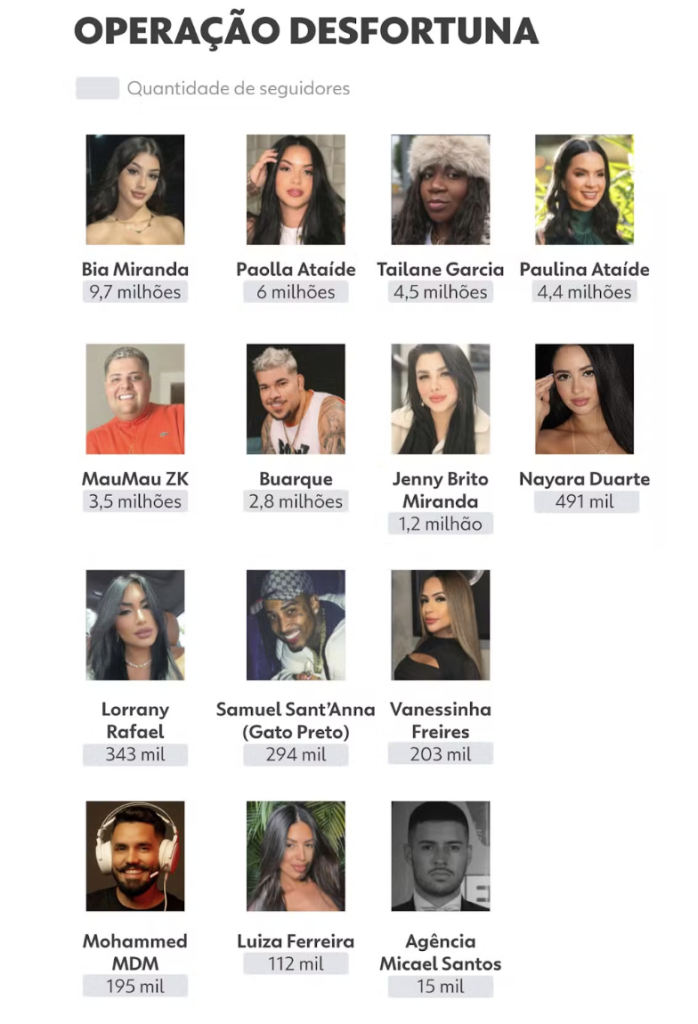
One of the most notable arrests is that of Maurício “Maumau ZK”, detained in São Paulo following the discovery of an unregistered firearm, its serial number removed at his home.
Following his arrest, in footage filmed from his prison cell, Maumau contested the charges, declaring: “I’m not a thief, I’m not a criminal.” He insisted the firearm was part of a publicity stunt and maintained that his involvement with online gambling was limited to a marketing agreement. He was released the same day on R$151,800 bail, the maximum allowed for illicit weapons possession, now subject to strict court-imposed restrictions.
Another central figure is Tainá Sousa, apprehended under Operation Dinheiro Sujo. She is accused of orchestrating a criminal syndicate that promoted unlicensed online gambling and allegedly compiled a “hit list” targeting journalists and officials who criticised her actions. Videos released from her detention show Sousa pleading her innocence and reminding her followers that “detention is not equivalent to guilt”.
Blurred Lines
Prior to the arrests, the Senate had commissioned a probe to examine the liabilities of influencer marketing and public policy in Brazil, and its influence prior to the launch of the Bets regime on 1 January.
Back in April, Senator Soraya Thronicke, rapporteur for the Parliamentary Inquiry Commission (CPI) on the “Bets” regime, confronted Virginia Fonseca, Brazil’s most-popular Gen‑Z influencer, about her role in promoting online gambling to her 50 million followers. Fonseca defended herself, noting: “CONAR has no laws prohibiting the promotion of gambling websites, and my content was aimed at over‑18s.”
The inquiry’s fallout remains potent amid Senate ranks. SBC Notícias Brasil reports that Senator Humberto Costa has introduced Bill 3754/2025, seeking to raise the legal betting age from 18 to 21 and impose a maximum monthly spending cap equal to one minimum wage.
Costa decried the human cost of the burgeoning industry – “In July, a son killed his own mother in Minas Gerais over debts from Bets,” he said.
“Money meant for groceries… is being drained into Bets. Many young people of university age are either delaying enrolment or dropping out of college because their tuition money is being spent on gambling, even with the support of Fies.” He added: “Bets should not even exist.”
If passed, the bill would ban advertising between 6 a.m. and 10 p.m., bar sponsorship of any public cultural, sports or artistic event, and prohibit any gambling marketing directed at under-21s
When the CPI concluded its inquiry in June, Senator Thronicke presented 20 recommendations aimed at tightening Brazil’s nascent regulated betting regime.
Though it avoided setting hard advertisement rules—deferring that assignment to CONAR and Brazil’s Secretariat of Prizes and Betting (SPA) the report did propose banning “others’ misfortune” clauses in operator agreements, and it called for prohibiting “promotional incentives” such as loyalty programmes and rewards.
Brazil Judiciary faces twists-&-turns
This is a moment of reckoning for Brazil’s online gambling market. Since the Bets regulatory regime was launched in January 2025, the sector has ballooned in visibility and revenue.
The International Betting Integrity Association (IBIA) has formed a Payment Providers Forum, with members such as Bazk, Z.ro Bank, OneKey Payments, OKTO, VPag, and Pay4Fun, to block transactions for unlicensed operators — a group projected to handle over 70% of Brazil’s remote betting turnover by 2028. Members view many that a firm response is overdue. As one senior executive told SBC Noticias Brazil that “This industry cannot grow clean unless the rot at the edges is excised.”
As the industry grows, so too does scrutiny—from law enforcement, legislators, and public opinion. The key question: can the state dismantle a network of influencer-driven illicit promotion and enforce new rules while the lines between regulated and unregulated remain faint?
Legal scholars warn that securing convictions under Operation Desfortuna will be challenging, given that much alleged wrongdoing occurred in the pre-regulatory era’s “grey zone.” Defendants will likely argue that they engaged in no criminal wrongdoing at the time, and that a lack of clear rules renders many charges suspect.
If Operation Desfortuna results in convictions, pressure will mount on the Senate to determine the criminal liabilities of online gambling prior to the markets legal existence, establishing a remit for retroactive penalties and prosecution of offences.
As stands, the arrests of Maumau, Fonseca, Sousa, and others, coupled with mounting legislative pressure, mark a pivotal chapter in Brazil’s struggle to assert control on the exposure of illicit gambling to Gen-Z audiences, as authorities seek to avoid another sensationalist fallout dragging the nascent Bets regime back into national headlines.
September 15 will see SBC organise a groundbreaking charity football event in Lisbon. Make sure you get the chance to see some of the most legendary names in football by securing your ticket today at https://www.legendscharitygame.com/