





The Ministry of Consumer Affairs of Spain has raised concerns over a noticeable growth in the number of women engaging in online gambling.
New insights published on 2024 data by the Dirección General de Ordenación del Juego (DGOJ), Spain’s Directorate of Gambling, recorded a 23% increase in the number of female players, representing the addition of almost 64,000 new women engaging in online gambling over the course of a single year.
Deeper analysis points to the Ministry’s concern that 60% of the total segment are aged under 35. The DGOJ was instructed to explain why it had recorded such an exceptional trend in 2024, and whether it reflects an anomaly in Spanish gambling participation or signals a structural shift in player demographics.
As cited: “The number of female players increased by 23.53%, meaning that almost 64,000 more women gambled online in Spain. This percentage is also higher than the growth in the number of male players during that same period.”
The Directorate undertook a first-hand analysis of available data from licensed gambling operators to provide its first gender-segmented breakdown of Spain’s online gambling market.
Its review aimed to “identify differences in gambling and power patterns, and thus adapt public policies to this reality”.
The headline observation is that, despite the 2024 surge in female players, online gambling in Spain remains heavily male-dominated. Women who actively gamble represent approximately 16.9% of total players – around 335,000 individuals out of a total pool of nearly two million online gamblers.
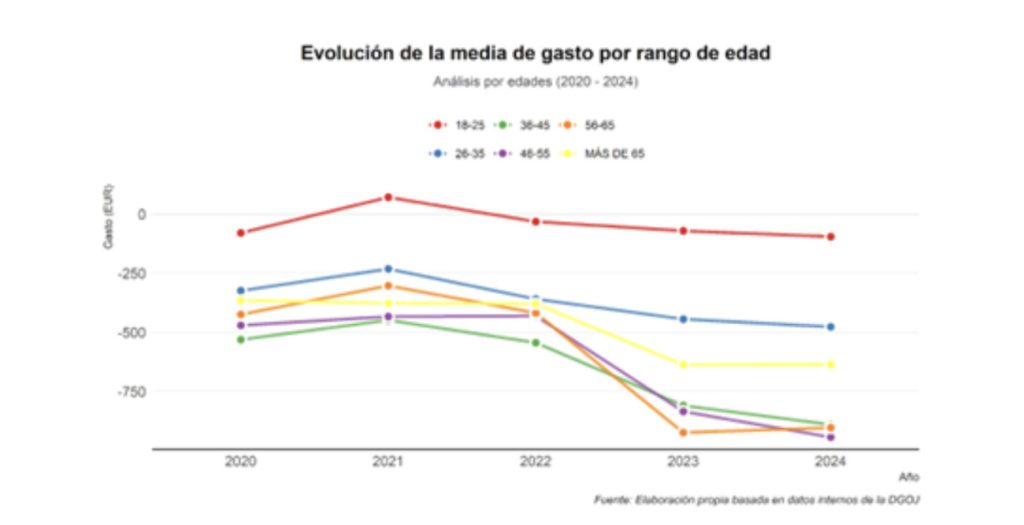
Of significance, the report highlights several distinctive behavioural patterns among female players. Women tend to “deposit less capital on average than the general player-base, with annual deposits estimated at around “€2,019 compared to €2,482 across the wider market.”
SBC News has recognised that this is a particularly high deposit value figure for Spanish players compared to other European markets.
Losses also appear more contained, with the “average net loss standing at approximately €539”, suggesting that expenditure among female players is concentrated within a relatively small cohort.
Research coincides with tax disclosure demands
Beyond participation trends, the DGOJ also flagged a disproportionate presence of women in identity-theft complaints linked to online gambling accounts, a trend formerly reported on by State Agency for Tax Administration (AEAT) and its enforcement campaign of Protocol for Action for Impersonated Taxpayers (PACS) – undertaken since 2023.
Nearly 46% of reports filed under Spain’s PACS protocol for impersonated taxpayers were submitted by women, despite their lower overall participation in gambling activity.
The PACS campaigns reported to Spanish police that nearly 5% of all individuals who won more than €100 in online gaming were victims of impersonation.
In the 2022/2023 tax year, AEAT implemented changes to Spanish gambling’s tax modules, which saw the tax agency lower the disclosure on tax winnings from €1000 to €300 – a 20% tax charge that must be filed on a yearly basis.
In relation to gambling winnings, in 2022 the Ministry of Finance authorised AEAT to update Tax Module-190 to ensure the reporting of gambling prizes and winnings under €300, impacting 2023 tax filings.
However, during 2024/25, the DGOJ was warned by Spain’s Tax Administration to order gambling licence holders to ensure customer input or update Spanish tax credentials to ensure that gambling winnings were filed with the authority.
Regulators noted that this dynamic may point to vulnerabilities linked to digital security practices, financial oversight within households, or the fraudulent use of female identities in account registration.
The Ministry’s observations coincide with ongoing efforts by Spanish regulators to strengthen oversight of player spending across the online gambling sector.
The DGOJ had previously outlined plans under the Royal Decree on Safer Gambling Environments to introduce a universal deposit monitoring system.
The scheme was designed to track player deposits across all licensed operators and ensure compliance with both DGOJ orders as well as wider authorities such as AEAT orders on tax duties.
Under Spain’s current framework, statutory limits restrict how much a player can deposit: €600 per day, €1,500 per week and €3,000 per month — though these caps historically applied on a per-operator basis, allowing players to potentially exceed limits by spreading activity across multiple platforms.
Decree controls must be adopted
The system was originally scheduled to become operational by March 2026, but industry sources indicate that the DGOJ has yet to initiate a beta testing phase, leaving uncertainty over when Spain’s long-anticipated unified deposit monitoring scheme will be implemented.
The regulator has maintained that the reform will improve consumer protection and strengthen the monitoring of gambling receipts for taxation and compliance purposes across the licensed market.
The implementation of a universal deposit monitoring system is viewed as one of three key policy objectives the DGOJ has pledged to launch from 2026 onwards.
The measure is expected to be introduced alongside broader reforms, including stricter advertising restrictions aimed at restricting “gambling like tobacco”. The third objective aims for Spain to become the first European jurisdiction to mandate AI-based algorithm upon gambling licences to help detect early indicators of gambling disorder and strengthen preventative safeguards
The Ministry concluded its update by citing that the findings do not yet indicate a structural shift in the gender composition of Spain’s gambling market.
The DGOJ maintains that its analysis forms part of a broader effort to refine regulatory oversight and consumer-protection policies under the Ministry of Consumer Affairs Agenda for 2030. The objective seeks to provide wider authorities to understand emerging trends and liabilities within the country’s regulated online gambling regime, undertaking changes as determined by the Royal Decree on Safer Gambling Environments.