




Keisha Bailey – iGaming Writer and Industry Expert at CasinoRank takes a look at the biggest and most popular games of 2025.
The iGaming landscape underwent a profound shift in 2025 and the latest cross-market analysis from CasinoRank confirms just how dramatically global player behaviour has diverged.
For the first time, the data shows four entirely distinct performance ecosystems emerging across Asia, Europe, LatAm and North America. Games that dominated in one region barely surfaced in another. Mechanics that resonated with one audience fell flat elsewhere. And suppliers known for global hits discovered that regional alignment, not worldwide momentum, is now the determining factor of success.
This transformation isn’t simply an interesting observation; it is a signal of where the market is headed. Operators and suppliers who pay attention to these regional patterns will have a competitive advantage in 2026, while those who rely on outdated global uniform strategies risk losing ground.
A Global Snapshot: Four Regions, Four Different Realities
The most striking finding in the study is how sharply the world’s top-performing games diverged between regions. Asia is the only fully aligned market. Here, the same titles- Gates of Olympus, Sweet Bonanza, Starlight Princess and their high-volatility “1000” variants, dominated every one of the seven tracked countries. The consistency of these rankings shows not only the strength of Pragmatic Play’s portfolio, but also how deeply Asian player preferences converge around fast, high-clarity mechanics. In regions where gameplay needs to be thrilling, immediately understandable and optimised for mobile, the formula is predictable and powerful.
Europe, on the other hand, looks like a completely different industry. No title appeared in more than two countries and the top charts carried virtually no overlap. Spain gravitated toward Live Sportium Roulette, Latvia leaned into 123 Bingo and Denmark favoured localised blackjack formats. The fragmentation here reflects Europe’s complex regulatory landscape, cultural diversity and growing appetite for live dealer formats that emphasise trust and authenticity over spectacle. Europe has effectively become a patchwork of micro-markets, each demanding localised presentation and tailored content decisions.
LatAm occupies its own middle ground. The region demonstrated meaningful alignment at the top of the charts; Forbidden City and Live Betano Spanish Gold Blackjack found widespread traction across multiple markets, but the similarities dissolved rapidly below the top tier. Performance became country-specific, shaped by differences in mobile penetration, player maturity, cultural preferences and financial infrastructure. Brazil, for example, showed enthusiasm for lightweight mobile slots, while Argentina preferred stable table-style formats and live dealer environments. LatAm’s hybrid profile suggests that operators must be flexible, adapting not just region-to-region but often country-to-country.
North America delivered yet another structural model. Rankings across both New Jersey and Quebec were perfectly standardised, with every top title appearing exactly 24 times. Rather than reflecting organic discovery or player-driven popularity, these identical charts represent controlled ecosystems where platform operators, through content placement, licensing agreements and brand-owned titles, shape what becomes visible. DraftKings’ proprietary titles dominated the charts alongside Evolution’s established table games. In North America, distribution power is the mechanic.
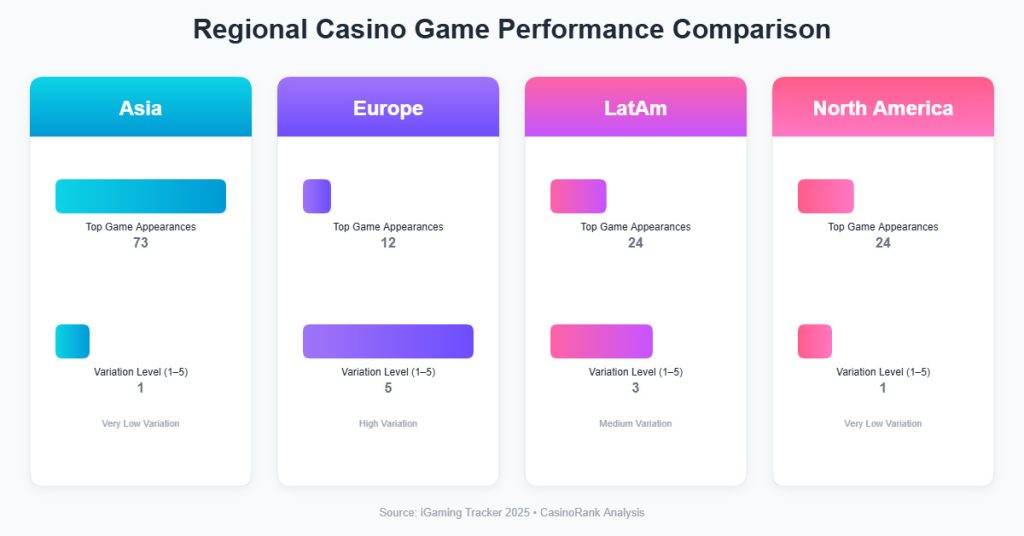
In the accompanying visualisation, these patterns become strikingly clear: Asia’s near-perfect chart alignment contrasts sharply with Europe’s fragmented distribution, LatAm’s layered hybrid behaviour and North America’s operator-driven uniformity.
Asia: Speed, Volatility and Mechanical Certainty
Asia’s player base demonstrated the strongest cohesion in the study. The region’s top games thrive because they deliver fast pacing, cascading action, escalating multipliers and simple pathways to understanding wins. These mechanics align perfectly with mobile-first consumption, where short but high-intensity sessions dominate. You should approach the region with volatility architecture at the forefront of your design and distribution decisions. Players expect clear progression and dramatic moments and games that fail to deliver this rhythm simply do not perform.
Europe: Localisation as a Competitive Edge
In Europe, everything revolves around trust and cultural relevance. Players increasingly gravitate toward live dealer formats because they offer clarity, transparency and a familiar social structure. Regulated markets in the UK, Sweden, Germany and others have trained players to prioritise games that feel local and are easy to understand. This creates a landscape where a one-size-fits-all portfolio will no longer work. If you want success in Europe, you need to invest in localised studios, native-language dealers, tailored UI decisions and compliance-first experiences. Global hits are no longer guaranteed to translate.
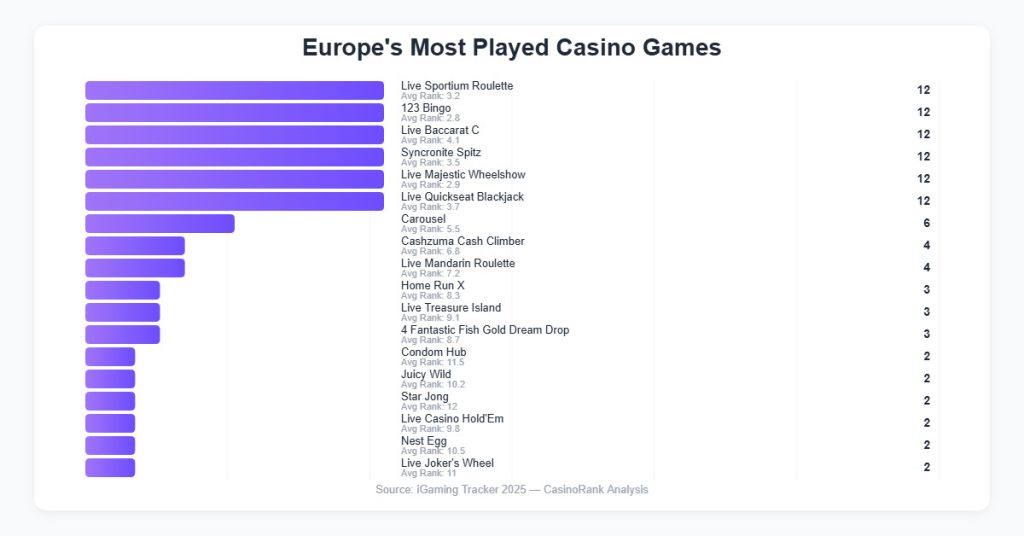
The Europe-only chart underlines this fragmentation, illustrating how country-level preferences diverge even within the same continent.
LatAm: A Growing Region With Hybrid Behavior
LatAm’s complexity and opportunity stem from its hybrid nature. The region blends mobile-first slot demand with rising engagement in localised live dealer content, producing markets where both can thrive simultaneously. This dynamic makes LatAm an attractive testing ground for content variety. However, you must avoid treating the region as a monolith. Market maturity differs widely and so do player behaviors. Brazil’s fast-paced mobile ecosystem calls for lightweight interfaces; Argentina requires deeper trust-building formats; Mexico responds to familiar mechanics rooted in legacy online casino culture. The operators seeing the strongest returns are those who adapt to these distinctions rather than rely on regional generalisations.
North America: Distribution Determines Performance
North America demonstrates the clearest example of platform power shaping player behaviour. When every top game appears exactly 24 times, it’s clear that operator curation—not organic interest—drives visibility. Proprietary games, loyalty-integrated experiences and established table formats rise to the top because they are placed there. If you aim to enter or grow in this market, the priority is not just strong content but strong partnerships. You need alignment with platform strategy, optimised integration and compliance readiness. Mechanics matter, but distribution determines the outcome.
Interpreting the Data: What Operators Should Take From 2025
The 2025 dataset marks a departure from the era when global hits were expected to perform everywhere. Instead, regional logic now governs performance. Asia rewards mechanical intensity and fast feedback loops. Europe rewards cultural familiarity and authenticity. LatAm rewards adaptable UX and flexible content strategies. North America rewards the titles elevated by platform ecosystems. If you continue designing and distributing content with global uniformity in mind, you will miss opportunities and face higher churn.
A region-specific approach is no longer optional; it is foundational.
Strategies for 2026 and Beyond
To align with the industry’s new trajectory, you should invest in region-first portfolio planning. Localise deeper than translation, shaping volatility profiles, pacing and presentation to align with the behavioural patterns of each market. Live dealer customisation will be essential for Europe and parts of LatAm. In Asia, volatility will remain the leading engagement driver. In North America, success will depend largely on licensing agreements, integration quality and platform visibility.
It is equally important to use data dynamically. Markets are moving quickly and static annual planning is no longer enough. You should refine your portfolio continually using performance feedback. This agility will distinguish operators who grow from those who stagnate.
For a comprehensive breakdown of the data behind these behaviours and how operators can act on them, read CasinoRank’s full analysis expanding on the year’s most defining performance trends.
Conclusion
2025 has officially dismantled the idea of a unified global casino audience. We now operate across four distinct behavioural ecosystems, each with its own player psychology, regulatory environment and engagement patterns. Asia rewards volatility. Europe rewards authenticity. LatAm rewards flexibility. North America’s rewards platform strategy. Operators and suppliers who understand these identities and build their strategies accordingly will shape the next phase of industry growth.
The message from the data is clear: regional precision is no longer a competitive advantage. It is the cost of entry.