




In an unprecedented move President Erdoğan has signed an action plan, ordering all of Turkey’s government bodies to combat illegal gambling.
Erdoğan is demanding effective results by 2026, as he sticks to his pledge to Turkey’s citizens and families that his government will eradicate illegal gambling by any means necessary.
On Saturday 1 November, the Resmi Gazete announced that President Erdoğan had signed the “Action Plan for Combating Illegal Betting, Games of Chance, and Gambling in Virtual Environments (2025–2026)”.
The circular formally launches the AKP government’s 2025–2026 action plan aimed at tackling illegal betting, games of chance, and illicit online gambling, with national authorities reporting directly to Erdoğan.
As cited by the document: “Illegal gambling activities have undermined Turkey’s family unity, weakened social relations, and particularly targeted young people and all segments of society, not only cause harm but also increase the size of the unregistered economy and create grounds for the laundering of criminal proceeds, thereby posing a serious threat to public order.”
“Therefore, effective measures against illegal betting, games of chance, and gambling are of vital importance for ensuring public security, maintaining the integrity of the social structure, and sustaining economic and social welfare.”
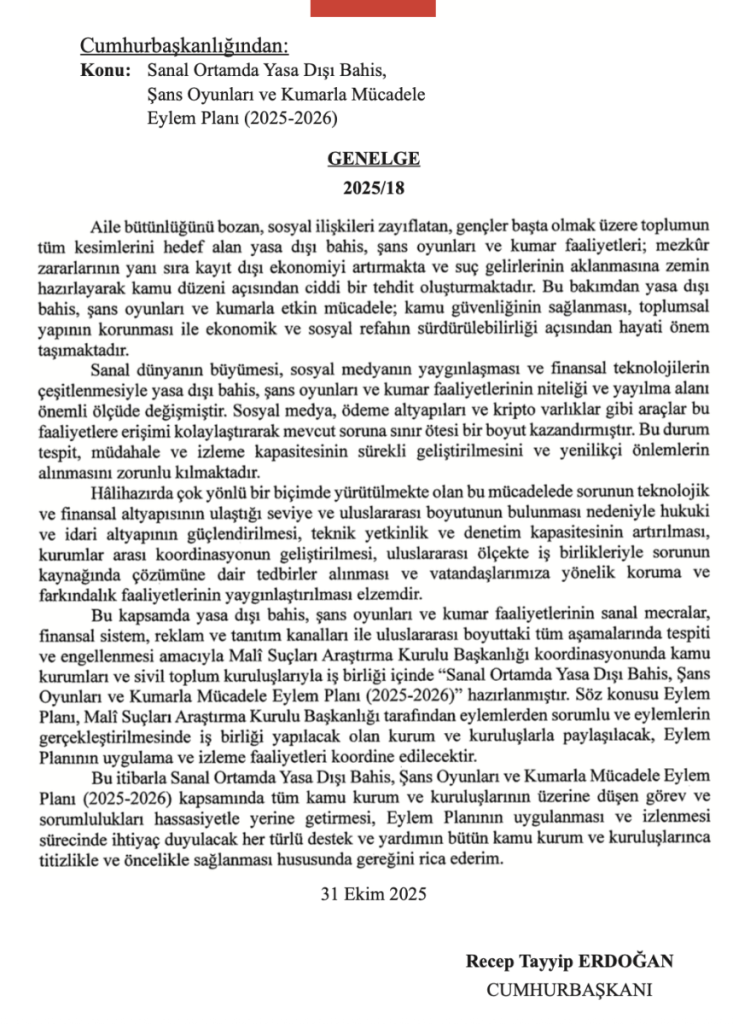
The president’s signature carries utmost intent, as Turkey’s fight against illegal gambling sits at the top of the AKP agenda.
Weeks of media coverage have highlighted Turkey’s vulnerabilities to gambling addiction among under-18s — an issue brought to life by investigative media exposés and, of political significance, drawing criticism of the government from pro-AKP outlets such as Sabah and the outlets of the Albayrak Media Group.
Furthermore, Yeşilay (the Green Crescent) Turkey’s heritage public-health NGO warned in its Turkey Gambling Report that gambling-related cases now account for 28% of all addiction consultations, reflecting the growing demand for specialised treatment services.
In a cabinet meeting prior to publishing the action plan, Erdoğan admitted “shame” at the escalation of a national crisis and pledged that illegal online gambling would be eradicated before Turkey’s next election call in 2027.
2025 battle scars
The 2025 enforcement drive has shown the depth and complexity of Turkey’s illegal gambling networks, which continue to evolve faster than regulators can act.
Authorities have shut down hundreds of unlicensed betting sites and crypto casinos, yet many have simply migrated to new domains, social platforms, or payment gateways, exposing the challenge of controlling cross-border digital markets.
The Papara scandal became the most significant revelation of the year, after the Istanbul-based fintech’s CEO was charged with enabling ₺12.9 billion (€340 million) in illegal gambling transactions through over 26,000 user accounts.
Investigations by MASAK and Turkey’s National Intelligence Organization (MIT) indicate that the state now possesses a comprehensive map of gambling operators and technology providers actively targeting Turkish consumers, including those funnelling funds through offshore exchanges, wallets, and payment APIs.
These findings have reinforced Ankara’s view that the black market is a national security threat — one that cannot be dismantled through domestic policing alone.
A multi-agency coordination
The circular mandates a whole-of-government mobilisation, led by the Financial Crimes Investigation Board (MASAK), which will act as the central coordinator across ministries, regulators, and law enforcement agencies.
Under the action plan, MASAK is responsible for detecting and disrupting the financial lifelines of illegal gambling — from banks and fintech operators to crypto-asset gateways and peer-to-peer payment tools.
As such, the intelligence agency will coordinate directly with multiple branches of government to enforce the new framework, including the Ministry of Interior, which commands cybercrime units and provincial police.
the Information and Communication Technologies Authority (BTK) will be responsible for blocking access to gambling websites, apps, and related digital platforms; the Ministry of Treasury and Finance, will tighten payment surveillance and anti-money-laundering measures;
The Ministry of Justice, has been authorised to priortise prosecutions and evidence-handling procedures of illicit gambling cases, and the Directorate of Communications, which will oversee the removal of gambling promotions and paid influencer content.
Together, the relevant bodies will deliver what the circular defines as a “comprehensive and nationwide (ulusal çapta) effort encompassing virtual, financial, and promotional channels to restore control over Turkey’s online environment.”
Shots fired on tech, media, and foreign states
The circular issues stern warnings to Turkey’s domestic technology firms, media broadcasters, and social platforms, accused of indirectly supporting illegal gambling through lax content moderation, advertising sales, or influencer collaborations.
Media houses are instructed to reject gambling-linked advertising, while social-media companies and app stores face new oversight measures for any content that facilitates unlicensed play.
Failure to comply could result in license reviews, fines, or access restrictions by the BTK.
At the international level, Ankara is targeting foreign jurisdictions alleged to host or license illegal operators that target Turkish consumers, notably those located in Malta, Montenegro, Cyprus, North Macedonia, and Georgia.
Turkey’s government will pursue bilateral cooperation and, where necessary, apply sanctions against non-compliant states or entities that enable cross-border gambling networks.
As the circular states: “Although this fight is currently being carried out in a multifaceted manner, the technological and financial infrastructure achieved by these activities and their cross-border dimension make it essential to strengthen the legal and administrative infrastructure, increase technical competence and inspection capacity, improve inter-institutional coordination, promote cooperation with international organizations for resolving the issue at its source, and expand awareness-raising activities to protect our citizens.”
This statement positions illegal gambling as both a domestic and transnational threat, framing Turkey’s crackdown within a broader financial-crime and cybersecurity context.
Opposition places all blame on AKP
The opposition has criticised the government for acting late on a problem it has known about for more than a decade.
CHP figure Muharrem İnce accused the AKP of “political theatre,” arguing that “if the state had the will, it could have ended online gambling in three days back in 2014.”
Other parties, including the Yenilik Partisi (YKP), suspect the crackdown will stop short of exposing politically sensitive connections within Turkey’s financial and technology sectors.
At the same time, the AKP has no intention of reviewing or liberalising Turkey’s strict gambling laws, which reserve all wagering rights to state-controlled monopolies — Spor Toto for sports betting and the Milli Piyango for lottery and instant games.
The government insists that prohibition, reinforced by enforcement, remains the only viable model for protecting public order and social integrity.
Erdoğan needs a win
For many political observers, 2025 has been a year of turmoil for President Erdoğan and his ruling AKP.
His domestic credentials have been rocked by the handling of the Istanbul protests in March, triggered by the arrest of Ekrem İmamoğlu, the city’s mayor, who is widely viewed as Erdoğan’s most formidable opponent ahead of the 2027 elections.
Meanwhile, the AKP faces growing public discontent over its economic management. A surge in inflation, persistent foreign exchange volatility, and a rapidly weakening lira have eroded consumer confidence and household savings.
Adding to the strain, Turkey remains heavily dependent on imported energy, with no comprehensive reform plan yet delivered to ease the cost burden on citizens. Against this backdrop, Erdoğan’s anti-gambling campaign is as much a political test as a moral crusade.
Erdoğan needs a decisive policy victory to reassert his authority and stabilise his leadership, but the opposition views this moment as the weakest point in his 11-year presidency—as a once unassailable leader now faces mounting challenges from both the streets and the economy.