


BetStop has laid new ground for comprehensive self-exclusion on AUS gambling licences and states, a dynamic dependent on the Labor Party’s stalled review of gambling advertising reforms…
The government of Australia has been warned that the BetStop National Self-Exclusion Register (NSER) cannot be viewed as a “silver bullet to stop the rise of gambling addiction rates”.
The warning has headlined the review of the BetStop register by independent examiner and AUS public health expert Richard Eccles, who was summoned by the Australia Communications & Media Authority (ACMA) in October 2024.
The ACMA has submitted its first review of BetStop to ministers of the Commonwealth, providing an overview and breakdown of self-exclusion activities across six states and two mainland territories in Australia.
BetStop first came into existence in August 2023 as part of The Gambling Amendment Act, with an aim of applying urgent reforms to the Interactive Gambling Act 2001.
The stewardship of the self-exclusion register was granted to the ACMA, as BetStop was rolled-out as Australia’s first federal-wide gambling protection tool, later followed by the federal ban on credit card transactions for gambling.
To date, BetStop has gathered 53,300 registrations since its inception, of which its system currently maintains 34,266 users under self-exclusion from gambling.

Anika Wells, Australian Minister for Communications, said: “It’s fantastic that the independent review has confirmed BetStop is making a meaningful difference in protecting vulnerable Australians from gambling harm.
“I am writing to key stakeholders regarding the release of the BetStop Review report, including relevant State and Territory Ministers, to ask that they look for opportunities to strengthen the promotion of BetStop within their networks.”
Ministers have been informed that 38% of BetStop users have chosen “lifetime self-exclusion”, meaning that they will receive no engagement nor marketing communications from Australian-licensed gambling firms. Meanwhile the remaining 62% of users are split between six month and year-long freezes on their gambling accounts.
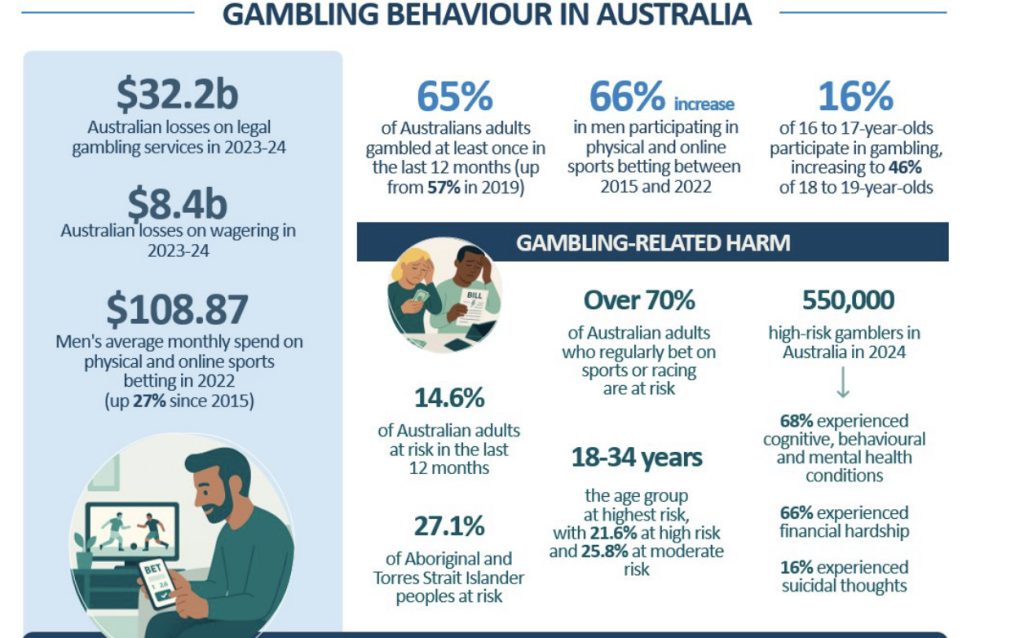
A cautious view of Problem Gambling in Australia
The review has noted that BetStop has succeeded in its founding goals of providing a federal protection against gambling harms and as a resource to gauge problem gambling of Australia. However, it was suggested that caution should be exercised when using BetStop insights beyond the remit of self-exclusion.
The report cites: “The NSER is performing an essential and much needed function protecting those at risk of harm from gambling. While it is not a complete solution in and of itself, it has become a fundamental part of broader strategies to address gambling harm.”
Providing a breakdown of state usership, it was New South Wales that recorded the highest usage of BetStop, with 17,000 users. That was followed by Victoria (14,500) and Queensland (11,000).
Most notably, it was also highlighted that 79% of the users were aged under 40 years old.
The review has underscored the need to maximise BetStop’s usage across Australia, especially for returning users. In fact, around 4,000 participants have extended their timeframe for self-exclusion, while 5,800 have reactivated self-exclusion following the expiry of activation periods.
As detailed: “Many people will, over a longer period, have multiple periods on the NSER. A pattern of an individual registering and cancelling exclusion could be a sign that they are experiencing gambling harm.”
A principal recommendation outlined in the review stated that the government must improve visibility and awareness of BetStop beyond gambling audiences.
It found that only 34% of consumers who wagered in the last 12 months were aware of BetStop, and only 26% of Australian adults knew of the self-exclusion register.
Awareness beyond Gambling audiences
Public awareness is key as only one in ten registrations are referred by a third party, such as a friend or family member – a key factor as those with a ‘support person’ were more likely to self-exclude for life (70% vs 56%).
“Now that the NSER is well established and its systems and administration mature and demonstrably effective, it is time for a renewed push to encourage more people to register,” the review added.
On technical grounds, the ACMA confirmed that it will consider applying a mandatory “three month minimum exclusion to all registrants including repeat users”.
ACMA confirmed that it will also back a measure to introduce a “support person” nomination at the point of registration to BetStop, combined with tougher requirements for users whose expiry from self-exclusion is due to be activated.
Forthcoming enhancements to BetStop will focus on improving direct access for specialised support services and improved integration of BetStop at land-based gambling venues.
Researchers call for “Improved links across self-exclusion registers and increased support options will ensure maximum impact for registrants and strengthen the system as part of a broader harm-minimisation framework.”
Of significant urgency, the review also calls on the government to impose marketing restrictions that prioritise the use of BetStop.
Australian gambling licensees must be instructed to default all marketing and promotions from any user that has registered with BetStop. The condition can only be removed via a specific signed opt-in by users.
To enable BetStop restrictions fully, due changes are needed to impose comprehensive definitions on “marketing material” to ban the use of push notifications of gambling apps and gambling promotions on social media.
The government and its ongoing review of gambling advertising has been instructed to apply comprehensive policies on marketing to limit communications to a limited remit required by law: “Anyone who has been on the NSER should, by default, be excluded from any marketing material, even once their registration has lapsed. It should require an unprompted, explicit agreement to recommence receiving marketing material.”
BetStop funded by cost recovery
The Review also supports the reassessment of cost recovery settings to ensure that the regulator is sufficiently funded to monitor breaches, investigate complaints and maintain system integrity with the clear principle that those profiting from online wagering should fund the scheme.
On funding directives, feedback notes: “It is recommended that the scope of activity able to be cost-recovered be regularly reviewed, to ensure that the ACMA is resourced to undertake increased compliance, enforcement and awareness raising activities.”
Where is PM Albanese?
Despite renewed scrutiny on gambling harms and the regulatory momentum generated by the BetStop review, the Labor government is yet to publish a determined bill which outlines reforms to Australia’s gambling advertising laws.
The matter stalled at the close of 2024, when Prime Minister Anthony Albanese declined to authorise the comprehensive, three-year phased ban on all gambling advertising recommended in the landmark report led by former Labor secretary Peta Murphy.
Instead, Albanese was reported to favour a diluted media proposal to cap gambling advertisements at two ads per hour on each channel until 10pm — a measure that was swiftly rejected by senior Labor figures and cross-party stakeholders as insufficient.
The PM now faces mounting pressure to clarify his position on gambling advertising reform and explain whether he ever intended to implement the core recommendations of the Murphy report.
Growing in voice, Australian gambling reform advocates have accused the government of “kicking the can down the road”. Opposition parties and Labor ranks have been told to seize the initiative and progress legislation and to take the matter away from Albanese hesitancy.
The matter has stained the premiership of Albanese, who pledged to install comprehensive advertising reforms upon winning the general election in May 2022 “deemed as a headline policy of a Labor government to protect 600,000 Australians experiencing severe problem gambling risks.”
For now, comprehensive advertising reform remains unresolved, with no draft bill tabled and no formal legislative pathway announced.