


The Bundestag of Germany has been warned that federal and state health agencies face a significant funding deficit in the treatment of addictions, including gambling-related harms.
The bleak outlook was submitted to the Bundestag via a joint statement coordinated by the Bundesärztekammer (The German Medical Association). Eight medical and treatment bodies aligned with the association have urged federal lawmakers to revise the taxation framework applied to alcohol, tobacco and gambling.

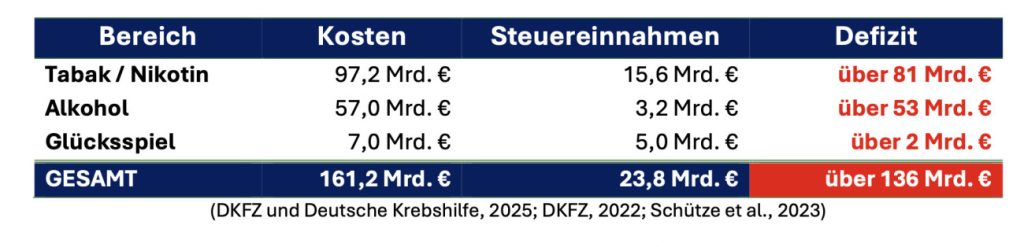
The signatories argue that Germany currently faces a structural deficit linked to addiction-related harms of more than €136bn annually, exposing what they describe as an ‘ineffective tax treatment of harmful adult products’.
€136bn societal deficit
Health agencies estimate that the total societal cost of addictions amounts to approximately €161bn. This figure reflects system-wide impacts including burdens on healthcare, welfare and social services, alongside broader economic losses such as reduced productivity, criminality and addiction-related mortality.
Across all three ‘adult consumption segments’, a clear tax revenue shortfall is identified. Tobacco and nicotine represent the largest imbalance, with societal costs estimated at €97bn against state tax receipts of €15.6bn.
Alcohol is cited as requiring the most urgent fiscal rethink. Agencies attribute €57bn in societal costs to alcohol consumption, compared with just €3.2bn in federal tax revenues — a shortfall exceeding €53bn.
Gambling carries the smallest nominal deficit, at just over €2bn, with societal costs estimated at €7bn against €5bn in tax revenue. However, agencies warn of disproportionate harm dynamics, citing research suggesting that up to 76% of gambling revenue is generated by individuals exhibiting problematic gambling behaviour.

The coalition calls on lawmakers to introduce minimum unit pricing for alcohol, raise excise duties across tobacco, nicotine and gambling, and implement comprehensive advertising restrictions, including bans on influencer marketing and digital targeting.
Urgency is particularly directed at alcohol taxation. The Bundestag is encouraged to reset Germany’s current alcohol tax framework, under which excise duties are calculated according to product strength rather than retail price. As a result, Germany’s alcohol taxation remains comparatively low relative to many EU member states, particularly when measured against final consumer prices.
Health wants levy & full advertising blackout
The regulatory treatment of gambling should also be reconsidered on an addiction-prevention basis, according to the statement. Agencies support the introduction of a full advertising prohibition on gambling, covering sponsorship, product placement, social media endorsements and data-driven targeting.
They further argue that gambling sponsorship in German sport constitutes a visible normalisation of addiction risk, calling for the removal of betting sponsorship from sports competitions.
In addition, gambling operators should face strengthened enforcement and oversight under the Glücksspielbehörde (GGL), Germany’s federal gambling authority. Agencies propose revenue-linked financial penalties tied to harm prevention failures.
Finally, the statement calls for expanded prevention and treatment funding, arguing that gambling operators should make a meaningful financial contribution toward harm mitigation — drawing comparisons with levy models implemented in other European markets, including the United Kingdom’s statutory gambling harms levy.
Evidence in still in question
In 2025 and 2026, the Glücksspielbehörde der Länder (GGL) has prioritised a coordinated programmes to strengthen cooperation with Germany’s state authorities, aiming to improve enforcement standards, regulatory consistency and consumer protection oversight across the federal structure.
However, German authorities have yet to resolve several outstanding liabilities and operational tensions arising from the GluNeuRStV 2021, the Fourth Interstate Gambling Treaty that formally launched the regulated online market on 1 July 2021. While the framework established nationwide licensing for online slots and poker, industry stakeholders argue that structural weaknesses remain unresolved.
Concerns continue to be raised by the Deutscher Online Casinoverband (DOCV) and the Deutscher Sportwettenverband (DSWV), both of whom maintain that regulatory assumptions underpinning the treaty no longer reflect market realities. Central to this debate is channelisation — the proportion of gambling activity occurring within the licensed market.
Both associations argue that current data relied upon by policymakers does not accurately capture the scale of offshore activity. Industry estimates suggest that channelisation rates in certain verticals may have fallen below 50%, implying that a significant share of revenues is flowing to unlicensed operators beyond German oversight.
The question of advertising will also return to the legislative agenda in 2026. The Bundestag and the Länder are expected to initiate a formal review of the interstate regime’s marketing provisions, with the GGL mandated to coordinate the process.
However, the authority has stated that it will not commit to policy changes until it receives the findings of forthcoming research commissioned in Bremen examining gambling participation levels, exposure to advertising and risk prevalence in Germany.
Interstate is a very slow-moving train
Licensed operators have been invited to submit formal recommendations to the process. Observers have previously told SBC to expect specific consultations for the next structural reform of Germany’s gambling framework to be proposed by the end of the decade to launch the “ GluNeuRStV 2029 regime.
As it stands, the signatories of the joint-letter frame tighter as Germany undertaking an ‘economic correction on addiction’, stating that where market prices fail to reflect societal harm, regulatory adjustment is required to internalise the true cost of consumption.
For many observers, Germany’s gambling reform increasingly resembles a slow-moving train — advancing incrementally through consultation rounds and coordinated reviews, but with its final destination still undefined.


