
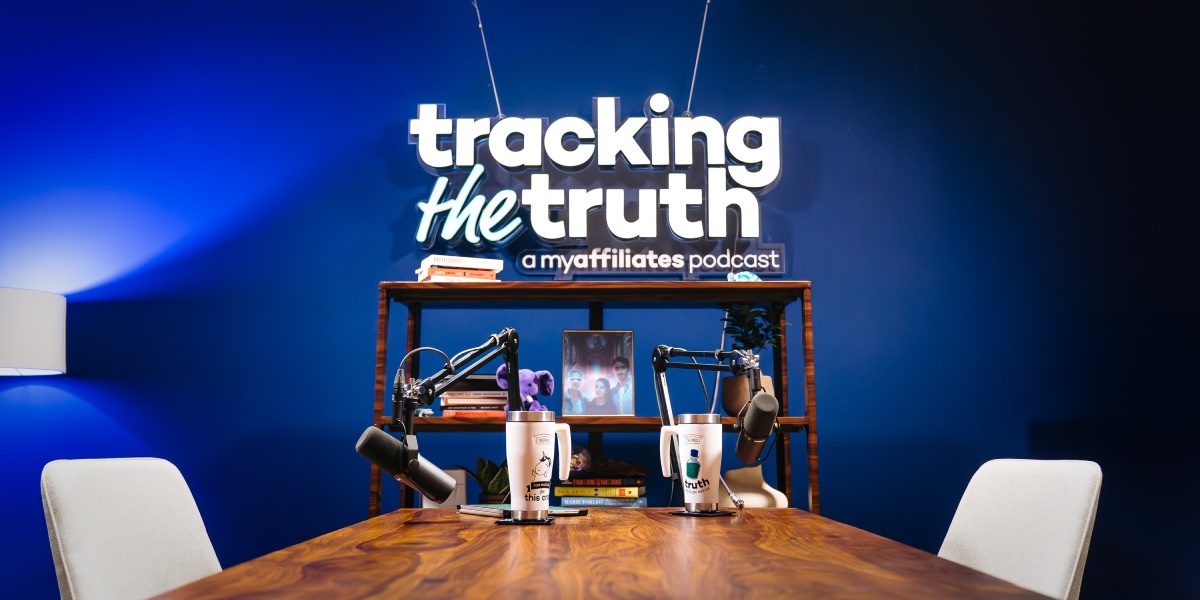
After a strong launch, Tracking the Truth continues to explore iGaming through candid, insight-driven conversations with industry professionals. Following Episodes 3 and 4, the MyAffiliates team goes over the key themes and practical insights raised across both discussions. Host Clemence Dujardin talked with Joe Hatch and Fabiola Olaso, and candidly addressed some of the segment’s main concerns.
This two-part series is about something the industry talks about in private, but rarely dissects in public: disappearing players, disputed numbers, and the uncomfortable gap between perception and reality.
Episodes 3 and 4 of Tracking the Truth take the same problem and examine it from opposite sides of the table. First from the affiliate perspective, then from the operator side. The result is not a clean winner. It is a clearer picture of where the friction truly lives.
Episode 3 – Vanishing Players
Guest: Joe Hatch.
Vanishing Players starts with a blunt premise: what happens when players don’t churn, don’t fail compliance, don’t obviously disappear, yet somehow stop existing in the affiliates view.
Joe frames the issue as a “revenue leak,” with shaving and downgrading at the centre. Shaving is when players or revenue are removed from an affiliate account. Downgrading is more subtle; the player remains, but the commercial outcome changes. A lower rev share. A different calculation. Less money at the end of the month.
One line from the episode cuts straight to the tension: “If it’s legitimate, it should be communicated. If it isn’t communicated, then it’s theft.”
Joe is clear that there are legitimate reasons for removal: fraud, chargebacks, regulatory constraints. But silent changes destroy trust. And once trust is gone, every discrepancy becomes a battle.
More importantly, Episode 3 moves the conversation beyond villains. It questions the structure itself. Affiliates control traffic. Operators control data. When numbers don’t align, the side without data ownership is always negotiating from a weaker position
Add to that inconsistent definitions, unclear deductions, and revenue share deals that look attractive but lack precise calculation logic, and disputes become systemic rather than exceptional.
Joe’s frustration is not theatrical. It is structural. “Affiliates control the traffic, but they don’t control the data,” he says.
That imbalance shapes everything.

Episode 4 – Calling Out the Other Side of the Table
Guest: Fabiola Olaso.
Episode 4 deliberately flips the lens.
In Calling Out the Other Side of the Table, the conversation shifts to the operator view with Fabiola Olaso, a 20-year industry veteran
The same accusations are placed under scrutiny. Are players truly vanishing? Or is the market itself evolving faster than many are willing to admit?
Fabiola does not deny shaving exists. She acknowledges cases where numbers simply do not make sense, active players dropping off in ways that cannot be explained by normal churn.
But she also introduces a second layer: changing player behaviour, aggressive incentive traffic, bonus rotation, and the reality that “lifetime” attribution is far from uniformly applied across the industry
One of her strongest red flags is manual reporting. Affiliate programs are still uploading data every 24 or 48 hours instead of relying on automated technologies. Not because delays are inconvenient, but because they create room for interpretation before data reaches affiliates. In her view, automation reduces suspicion. Manual intervention invites it.
Episode 4 also surfaces a topic often underplayed publicly: affiliate-driven abuse. Incentivised traffic, coordinated CPA behaviour, organised groups manipulating deposit patterns, traffic designed to trigger payouts rather than create value
The message is not that affiliates are the problem, but that pretending abuse only flows one way is naïve.
Two angles, similar solutions
Across both episodes, a pattern emerges:
Opacity fuels mistrust.
Inconsistent definitions fuel disputes.
Lack of education fuels miscommunication.
Outdated terms fuel conflict.
Both guests, despite approaching from opposite sides, converge on a similar solution: transparency must be operational, not cosmetic. Clear attribution rules. Clear revenue calculations. Automated data flows. Defined traffic types. Written terms that reflect today’s market, not yesterday’s assumptions.
Episode 3 names the imbalance.
Episode 4 names the complexity.
Together, they expose something bigger than shaving or abuse. They expose an industry negotiating relationships without shared standards, shared language, or shared accountability.
And perhaps the most important takeaway from both conversations is this: mistrust does not start with fraud. It starts with silence.
Episodes 3 and 4 of Tracking the Truth are now live on YouTube and Spotify.


