

The European Casino Association (ECA) is calling for an urgent expansion in the remit of Europol to tackle the surge of the illegal gambling sector in Europe.
At a recent roundtable event in the European Parliament, ECA Chair Erwin van Lambaart shared a report that the illegal online gambling market aimed at European Union (EU) consumers increased by around 14% year-on-year to €91.6bn (2024: €80m).
The data comes fresh off the European Commission‘s (EC) proposal to reform the mandate of Europol and elevate its data capabilities and remit when it comes to tackling cross-border crime.
As part of the reform proposed by the EC, Europol will push towards more operational capabilities, with its remit being expanded to include bringing down the illegal gambling sector.
MEP Lukas Mandl stated: “Illegal online gambling is not a niche issue, it is a serious cross-border threat that touches on consumer protection, organised crime and the integrity of our internal market.
“Europol is a crucial partner for Member States, but we must ensure that its mandate and resources allow it to fully support the fight against these illegitimate activities.”
Mandl added that the ECA evidence showed that there are areas where more cooperation in tackling illegal gambling is needed.
“I will bring these insights into our parliamentary work and encourage colleagues cross-party to jointly go against the negative effects of illegal gambling, from mental health issues to existential disasters of individuals and entire families, so that we can better protect citizens and make a clear difference between criminal activities and those operators who play by the rules.”

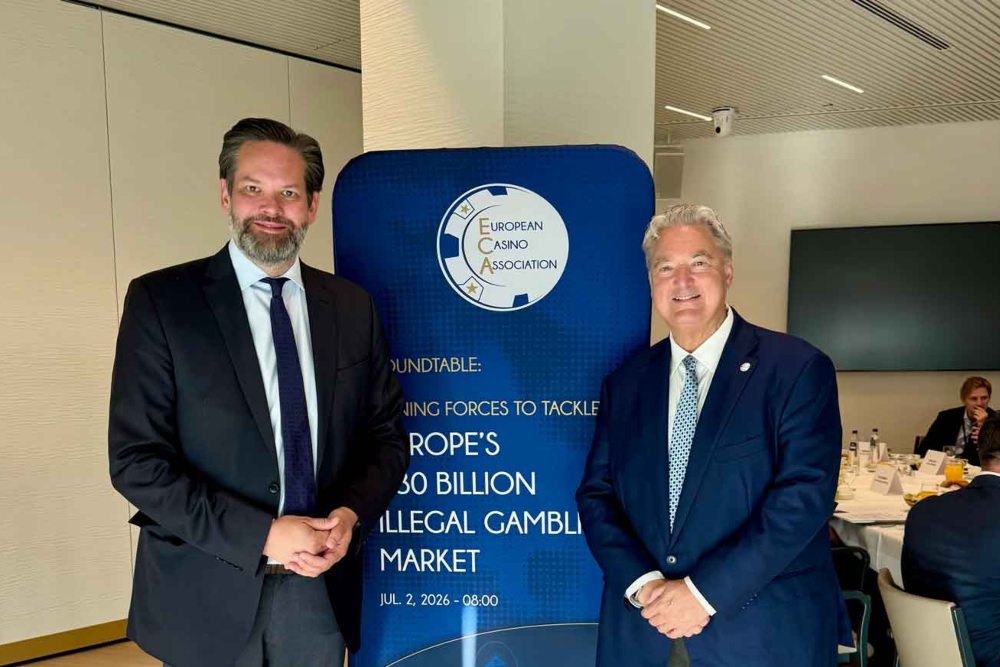
Van Lambaart also underpinned that the future of the regulated sector hinges upon stronger collaboration between all gambling stakeholders to tackle the illegal market across Europe.
“By connecting national enforcement efforts, financial intelligence units and sector expertise, European institutions and agencies such as the European Commission, Europol and AMLA can help us turn data into action.
“If we fail to act now, the illegal online market will continue to grow at the expense of players, public finances and legitimate businesses.”
The latest illegal online gambling in Europe report, conducted by Gambling Compliance International (GCI) and commissioned by the ECA, warned that the growth of the illegal market has deprived EU member states of an estimated €22.9bn in tax revenue.
No room for doubt
The ECA added that the report shows ‘illegal operators now account for the majority of online gambling revenue in the EU-27, that more than 6,200 illegal operators are actively targeting European consumers, and that the overwhelming majority of online gambling content Europeans are exposed to promotes illegal, unlicensed operators’.
Van Lambaart commented: “The 2025 data from the GCI report leaves no room for doubt: illegal online gambling is a fast-growing, cross-border problem that puts players, especially young adults, at high risk, deprives societies of much-needed tax revenues, and undermines trust in the regulated market.
“Licensed casinos and their online businesses operate under strict rules and invest heavily in responsible gambling and anti-money-laundering measures. Yet illegal operators, often based outside the EU, can reach European consumers at the click of a button, without safeguards, without oversight and without contributing to our communities.”
Hosted by Mandl, the roundtable saw EU lawmakers, the EC, the Anti-Money Laundering Authority (AMLA), Eurojust, the Joint Parliamentary Scrutiny Group (JPSG) on Europol, national gambling regulators and industry experts come together to discuss illegal gambling.
Views from all participants on illegal online gambling were exchanged under the Chatham House Rule, including its growth, how it’s currently tackled, and what more can be done at a European level, calling for stronger enforcement and cooperation.
Digital Services Act
Many industry stakeholders have cited social media platforms as being one of the key reasons why illegal gambling is being allowed to grow at its current rate, as their promotions aren’t being taken down quickly enough. However, the EC believes it already has the legislation in place to tackle the matter.
Last month, the EC emphasised that the Digital Services Act (DSA) can help in the fight against illegal gambling, stating that its capacity allows EU member states to combat and penalise the “promotion of unlicensed online gambling.”
This was in response to a written question submitted to the EC by MEP Sabine Verheyen (PPE), a representative of Germany’s Christian Democratic Union (CDU) and member of the European People’s Party Group (EPP).
Verheyen’s query noted that a 2024 study conducted by Yield Sec on behalf of the ECA found that “71% of online gambling activity targeting European users takes place on unlicensed, and thus illegal, websites”.
The German MEP further highlighted reports that content creators are actively promoting illegal gambling websites through affiliate marketing programmes on platforms such as YouTube and Twitch.
EC’s Executive Vice-President for Tech Sovereignty, Security and Democracy, Henna Virkkunen, acknowledged concerns relating to undisclosed advertising and the promotion of illegal products online, but stopped short of announcing a dedicated investigation into illegal gambling promotions.
She reiterated that the DSA already provides mechanisms through which illegal content can be identified and removed.
Virkkunen explained: “The Digital Services Act requires online platforms to provide a user-friendly notice and action mechanism ensuring users can report content, including advertisements, they consider to be illegal.”
She further noted that very large online platforms and search engines must assess and mitigate systemic risks linked to the dissemination of illegal content across their services.


